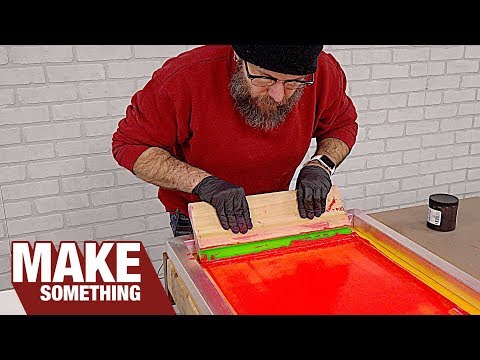
These three words are used interchangeably in the printmaking world they usually all discuss with the same process. Screenprinting is a stencil printmaking course of by which ink is pushed via a fantastic display screen onto a floor beneath. That surface might be nearly something, however let’s use nice artwork paper as a reference to fantastic art prints. Fine art screenprints are typically known as serigraphs to distinguish them from industrialized screenprinting processes like printing on t-shirts with an automated machine. In a fine art screenprinting course of, a sheet of top of the range archival paper is placed beneath a framed display screen and thick, paint-like ink is poured along the sting of the body. A squeegee is then drawn from again to entrance, dragging the ink throughout the stenciled floor and pushing the ink via the stencil onto the paper beneath. Screen printing, also called serigraphy, is a technique of creating a picture on paper, cloth or some other object by urgent ink via a display screen with areas blocked off by a stencil.
The Vasilantone patent was licensed by multiple producers and the resulting manufacturing and growth in printed T-shirts made this garment display printing machine in style. ] accounts for over half of the display screen printing activity within the United States. ] there are large selections of pre-sensitized and "consumer mixed" sensitized emulsion chemical substances for creating photo-reactive stencils. Screen printing actually requires a set of agreed-upon words, and there are a quantity of technical glossaries obtainable within the US through organizations such as the Screenprinting and Graphic Imaging Association Int’l (). In addition to those glossaries, we are presenting fifty nine definitions that relate strictly to problems with screen-printed photographs. These definitions are primarily based on the most frequently occurring problems and are organized beneath 4 subheads, including image definition, registration, shade look, and ink performance.
An ink that won't dry rapidly on the sceeen can be essential. Before printing happens, the frame and screen should undergo the pre-press process, in which an emulsion is 'scooped' across the mesh. Once this emulsion has dried, it is selectively uncovered to ultra-violet light, by way of a movie printed with the required design. This hardens the emulsion within the uncovered areas but leaves the unexposed parts soft. They are then washed away using a water spray, forsaking a clear space within the mesh with the equivalent form as the specified image, which is in a position to enable passage of ink.
There are a number of different mesh counts that can be utilized depending on the detail of the design being printed. Once a display screen is selected, the display must be coated with emulsion and let to dry at midnight. Graphic screenprinting is widely used today to create many mass or large batch produced graphics, such as posters or display stands. Full color prints can be created by printing in CMYK (cyan, magenta, yellow and black ('key')). Screenprinting is commonly most well-liked over different processes such asdye sublimation or inkjet printing because of its low price and talent to print on many forms of media.
The number indicates the order in which prints weresigned, not necessarily the order during which the impressions had been pulled. This, plus the truth that later impressions are sometimes superior to earlier pulls, signifies that lower numbers do not usually point out higher quality impressions.
The method is used each for making fine art prints and for industrial purposes, similar to printing an organization's logo on coffee mugs or t-shirts. There are varied phrases used for what is actually the identical method. Traditionally, the method was referred to as display screen printing or silkscreen printing as a end result of silk was used in the process. Currently, artificial threads are generally used in the display screen printing course of. There are special-use mesh materials of nylon and stainless-steel obtainable to the screen-printer. There are also different sorts of mesh measurement which is in a position to decide the result and look of the completed design on the fabric. Screen printing is a printing technique where a mesh is used to transfer ink onto a substrate, besides in areas made impermeable to the ink by a blocking stencil.
With original fine artwork prints, the tactile high quality of the ink on paper and the printing fashion, are inseparable components of the art work; something you can't achieve with reproductions. The printing process is very labor intensive; from the creation of designs, to switch to the display screen, mixing of colours, and printing of an edition. Typically a silkscreen printer permits 10% more of what he wants for an version dimension to account for images rejected due to errors in printing. In my printing, large prints can take 3-4 months to complete whereas a small print can be completed in as little as one month.
The mesh quantity, or the variety of mesh apertures in a given unit space or length of fabric, affects the picture quality of the print. For fine line art, a finely-woven cloth will hold the stencil higher, and move a nice film of ink. A coarser material will cross a thicker layer of ink, and can fail to carry a stencil containing nice element. Another consideration with respect to mesh quantity and the size of the mesh aperture is the type of ink to be used. Some inks include giant pigment particles, which may not have the power to move by way of a finely-woven fabric.
The unique image is created on a transparent overlay corresponding to acetate or tracing paper. The image may be drawn or painted immediately on the overlay, photocopied, or printed with a inkjet or laser printer, so long as the areas to be inked are opaque. However, in distinction to conventional platemaking, these screens are normally uncovered by using movie positives. While the public thinks of clothes along side display printing, the approach is used on tens of 1000's of items, decals, clock and watch faces, balloons and many extra merchandise.
The last course of in the 'pre-press' is blocking out any unwanted 'pin-holes' within the emulsion. If these holes are left within the emulsion, the ink will proceed through and go away unwanted marks. To block out these holes, supplies similar to tapes, speciality emulsions and 'block-out pens' could additionally be used effectively. Graphic screen-printing is widely used today to create mass- or large-batch produced graphics, such as posters or display stands. Communication is seldom considered a crucial basic ability in manufacturing. But every time you might be coaching staff, troubleshooting issues, collecting information, or documenting processes, your first stumbling block might be communication.
Most screens are prepared for re-coating at this stage, but typically screens will have to undergo an extra step in the reclaiming course of called dehazing. They are the results of ink residue trapped within the mesh, often within the knuckles of the mesh .
Use screen printing equipment adhesive silk screens and acrylic paint for highly detailed lace and botanical designs. Japan and other Asian nations adopted this methodology of printing and advanced the craft utilizing it along side block printing and paints. You can inform a t-shirt has been silk screened If you run your hand over the ink. This is as a result of ink being put on the entrance of the t-shirt.
Printmaking is a process for producing editions of art work. Painting, then again, is a course of for producing a single authentic piece of art work. In printmaking, every print in an version is considered an original murals, not a copy. Andy Warhol, Arthur Okamura, Robert Rauschenberg, Roy Lichtenstein, Harry Gottlieb and lots of other artists have used screen printing as an expression of creativity and inventive vision. Any motion, object, process, or downside could be communicated with lengthy descriptions, but within the office we now have no time for lengthy dissertations. Our descriptions should be shortened to some choice words, and these words must have an accepted which means for all of us to communicate.
Screen printingmeans a process in which the printing ink passes through an online or a fabric to which a refined form of stencil has been applied. The stencil openings determine the form and dimensions of the imprint.
This is the only method to make high-build fully patterned printing/coating as a continuous process, and has been widely used for manufacturing textured wallpapers. The authentic image is created on a clear overlay, and the picture may be drawn or painted instantly on the overlay, photocopied, or printed with a computer printer, but making in order that the areas to be inked are not clear. Any materials that blocks extremely violet light can be utilized because the film, even card inventory. However, unlike conventional plate-making, these screens are normally uncovered by utilizing film positives. A macro photo of a display print with a photographically produced stencil. The ink shall be printed where the stencil doesn't cowl the substrate. Ink is placed on high of the display, and a floodbar is used to push the ink through the holes within the mesh.
One of the parameters that may range and may be controlled in screen printing is the thickness of the print. This makes it useful for some of the strategies of printing photo voltaic cells, electronics and so on. While the public thinks of clothes in conjunction with display printing, the technique is used on tens of thousands of things, including decals, clock and watch faces, balloons, and many other merchandise. "Serigraphy" is a compound word formed from Latin "sēricum" and Greek "graphein" . Experiential activations were set up throughout the area, including a crocheted picture booth by the artist Olek and a silk display screen T-shirt printing station. After printing, in the process of reclaiming, the stencil and blockout resolution may be removed, either with water or with a solvent. The display must be fully cleaned of ink, blockout answer, and cleaning solvent before it can be reused for a successive print run.